TEL: +86-573-87471884 / 87471697
FAX: +86-573-87471537
Address: No. 205 Xinjiang Road Changan Haining, Zhejiang, China
E-mail: howardshen@263.net, goldcitylock@hotmail.com
Welcome to our website!

 Language

For distributors, importers, security-hardware wholesalers, and commercial-door suppliers, a rolling shutter lock is a small component with a direct effect on installation, access control, and after-sales cost. Commercial security and warehouse security remain active concerns in 2026, particularly around storefronts, storage facilities, and distribution sites.
For the buyer, though, the purchasing question is practical: will the hardware fit the shutter, work with the required key plan, and remain consistent when the order moves from sample to bulk production?
That is why a rolling shutter lock is better evaluated as part of the complete shutter application rather than as an isolated hardware item.
Bell padlocks, center locks, side locks, and integrated locking systems may all appear in searches for a roller shutter lock or roller shutter door lock, but they do not solve exactly the same installation problem. The shutter design comes first.
For importers handling several projects, that distinction matters. A lock that works on one storefront can be a poor match for another shutter with a different bottom rail, fixing position, or ground anchoring point.
For a new project, include a drawing or basic fitting dimensions in the RFQ. Retrofit work benefits from clear photos of the shutter bottom rail, fixing points, floor area, and existing locking position.
Before sample selection, confirm:
· Shutter or rolling-door type
· Manual or powered operation
· Available fixing points
· Ground anchoring position
· Clearance around the locking area
· New installation or retrofit
· Expected operating frequency
This information makes sample selection more accurate and reduces field modification after delivery.
A common issue appears when a distributor replaces locks across several stores. Two shutters can look almost identical from the front but use different fixing positions underneath. Finding that difference before the PO is routine. Finding it during installation is expensive.
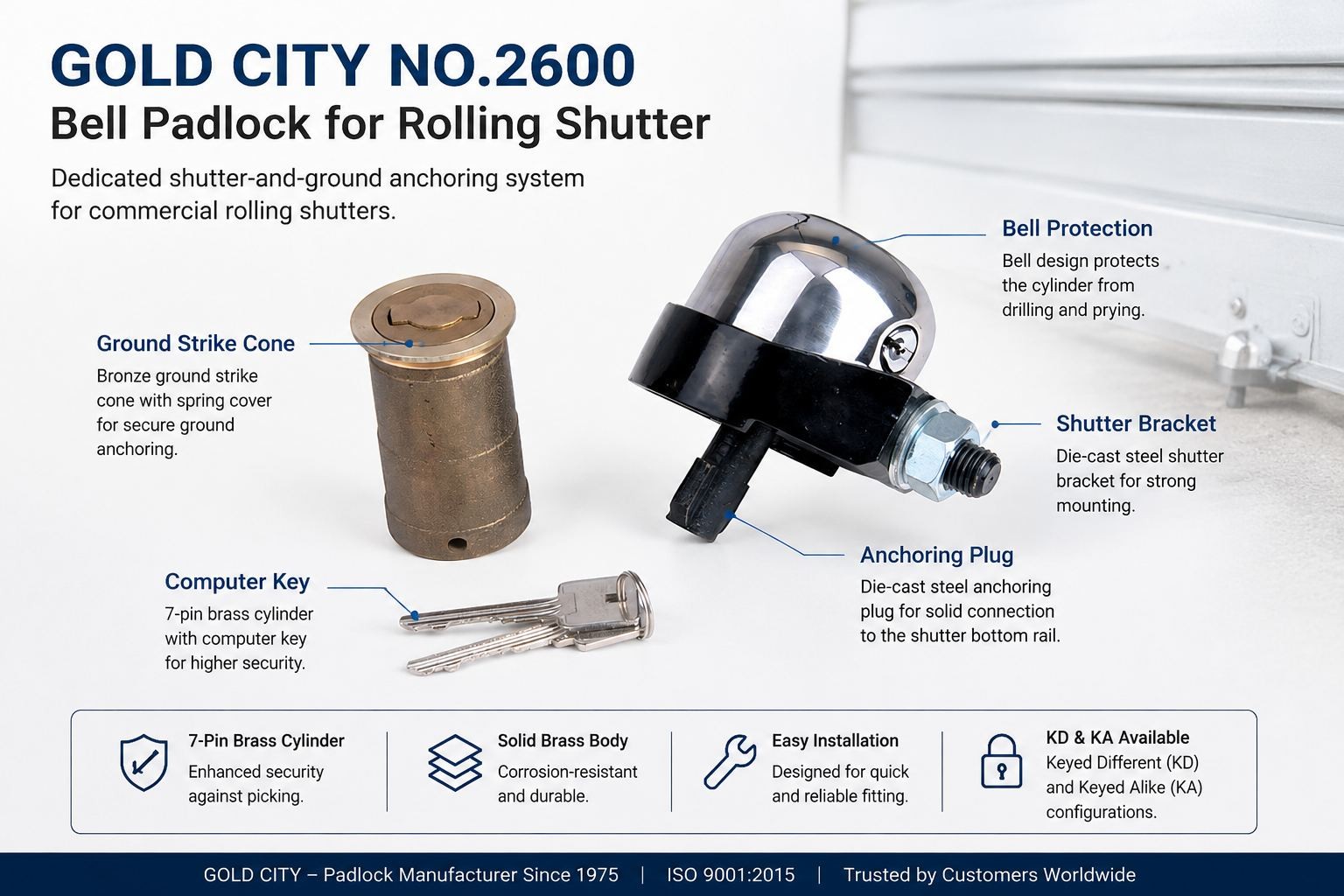
GOLD CITY Model NO.2600 Bell Padlock for Rolling Shutter uses a dedicated shutter-and-ground anchoring arrangement rather than functioning as a loose general-purpose padlock.
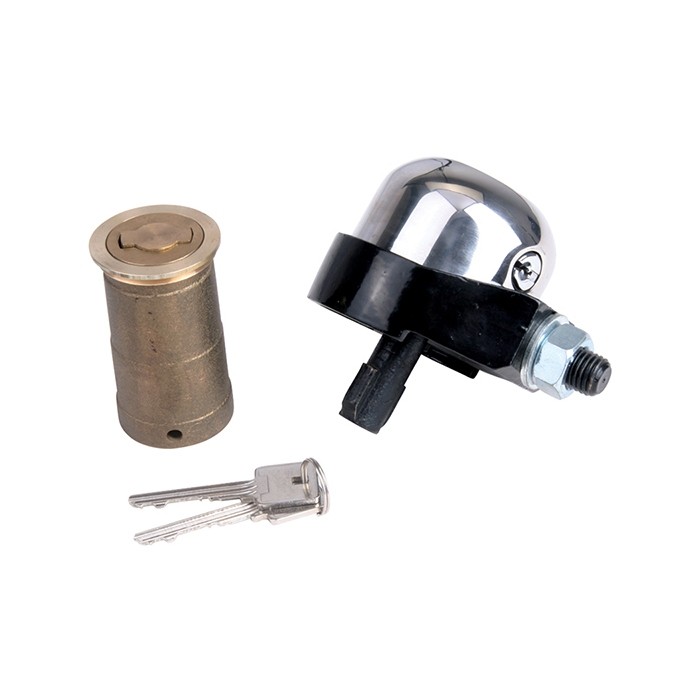
Its assembly includes a die-cast steel shutter bracket and anchoring plug, a solid brass internal body, a bronze ground strike cone with spring cover, and a 7-pin brass cylinder with bell protection. It operates with a computer key and is available in KD and KA configurations.
The useful point for procurement is not the length of the feature list. It is having a defined configuration that can be checked against the actual shutter before a commercial rolling shutter lock enters volume purchasing.
Once the locking format fits the application, the next comparison is about the specifications that affect operation and purchasing consistency.
Cylinder configuration, keying, anchoring, and component construction all influence how the system performs in daily use. They also give buyers a much better basis for comparing supplier quotations.
Broad terms such as “heavy duty” tell very little on their own. A heavier product or a higher pin count may look impressive on a quotation sheet, but neither confirms that the complete locking arrangement fits the project.
NO.2600 is available in keyed different and keyed alike configurations. The choice affects daily access management as much as the product specification itself.
KA works well where one authorized team operates several shutters. KD keeps access separated between doors, sites, or customers. A warehouse maintenance team and a distributor supplying unrelated retail customers therefore have very different keying needs.
For larger access-control projects, GOLD CITY's article on keyed alike and master key padlock planning covers key groups, access planning, and reorder records in more detail.
The decision also carries into repeat orders. A reorder can use the correct model and still create a problem if the original KA or KD arrangement was never recorded.
A useful technical comparison separates the locking system into the parts that affect mounting, operation, and physical protection: cylinder area, bracket, anchoring components, internal body, and ground fixing.
Instead of asking which supplier offers the “stronger” roller shutter lock, compare the agreed construction and installation arrangement on the same basis. That makes quotation differences easier to explain internally and reduces the chance of buying an impressive specification that adds little value to the actual project.
Once competing products are being compared on the same technical basis, price becomes more meaningful. Unit price, however, is still only part of the purchasing cost.
For overseas orders, freight, packing density, warehouse handling, installation changes, keying errors, replacement stock, and urgent reshipment can all change the economics of a purchase.
This is where detailed product and packing information becomes more useful than a low headline quotation.
For NO.2600, one carton contains six units and measures 45.5 × 35.5 × 13 cm. Net weight is 16 kg and gross weight is 17.5 kg.
Those figures can be built directly into freight and warehouse calculations when comparing more than one rolling shutter lock supplier.
A small saving on unit price can disappear once shipment weight, handling, or repacking is added. For larger orders, carton data also helps procurement teams estimate storage and shipping cost before finalizing the PO.
Wrong keying, incomplete fitting information, unclear labeling, or poor reorder records create a different kind of cost.
One incorrect sample is inconvenient. The same mistake repeated across a bulk order can mean extra labor, delayed installation, returns, or urgent replacement freight.
Before production starts, keep one agreed order reference covering the model, key configuration, packing requirements, and any project-specific details. Purchasing, QC, and production then work from the same target.
Getting the specification right on paper is only half the job. The next question is whether the supplier can reproduce it in the approved sample and production batch.
Sample approval moves the discussion from sales information to an actual purchasing decision. The sample needs to represent the intended production order, not simply prove that the lock opens and closes.
This stage is also the right time to settle keying, packing, labeling, production timing, and the records needed for future orders.
Where mounting geometry matters, test the sample on the actual shutter or a representative installation. Check the fitting position, locking action, keying type, agreed configuration, and packing basis together.
Lead time also belongs in this conversation. Sample and production schedules vary with quantity and project details, so confirm them for the actual order rather than working from a generic assumption.
Once approved, the sample and order record become the reference for purchasing, QC, production, and later reorders.
Repeat orders often expose gaps that were invisible on the first shipment.
Keep the original PO reference, model, key configuration, packing format, and any agreed labeling details. If a matching key arrangement may be needed later, raise that requirement at the first-order stage.
Routine site checks can include key operation, locking movement, mounting points, and the anchoring area. Inspection frequency depends on the actual environment and usage cycle; a fixed maintenance interval does not suit every installation.
For an importer, factory capability matters most when it supports consistent repeat supply. A large factory is not automatically the right supplier. The more useful question is whether the approved product, keying, and packing details can be reproduced when the next bulk order arrives.
GOLD CITY has manufactured padlocks since 1975, employs more than 200 people, and produces more than 10 million padlocks annually. Its management is accredited to ISO 9001:2015, and its products are supplied to international markets, particularly in Europe, America, and Asia.
That background becomes more relevant when a trial order turns into a recurring product line.
Packaging, labeling, documentation, and customer specifications can vary between markets and projects. Put those requirements into the RFQ rather than assuming one standard arrangement works everywhere.
This is especially useful when the importer supplies local distributors, commercial-door installers, or project customers. Clarifying destination-market requirements before quotation reduces changes close to shipment and makes supplier comparisons more accurate.
A rolling shutter lock is best sourced as part of the complete shutter application. Start with fit and anchoring, then compare the keying plan, construction, landed cost, sample approval, and repeat-order requirements.
Not every extra specification deserves extra cost. The useful features are the ones that solve a real purchasing or operating problem: easier installation, cleaner key management, clearer quality control, lower logistics risk, or more reliable repeat supply.
For distributors and importers evaluating a bell-style roller shutter lock, GOLD CITY NO.2600 provides a defined mechanical configuration for suitable shutter applications. To discuss a project, contact GOLD CITY with shutter photos or drawings, estimated quantity, KD or KA preference, destination market, packing requirements, and target delivery schedule.
A: Include the shutter type, installation or retrofit details, fixing and anchoring arrangement, quantity, keying requirement, destination market, packing needs, and target delivery schedule. Photos or drawings are particularly useful when the mounting arrangement is project-specific.
A: Compare the shutter bottom rail, fixing points, ground anchoring position, clearance around the locking area, and operating method with the proposed lock. For retrofit work, testing a sample on the actual or representative shutter helps catch fitting differences before bulk production.
A: Neither option is universally better. KA suits sites where one authorized team needs access to several locks. KD keeps access separated between doors, locations, or customers. The correct choice depends on the access plan and future reorder requirements.
A: No. Pin count is only one specification. Cylinder protection, anchoring, component construction, installation fit, and the complete locking arrangement all affect whether a product is appropriate for the application.
A: Confirm the approved sample, product configuration, KD or KA keying, packing and labeling requirements, destination-market details, production schedule, and the order references needed for future reorders.
TEL: +86-573-87471884 / 87471697
FAX: +86-573-87471537
Address: No. 205 Xinjiang Road Changan Haining, Zhejiang, China
E-mail: howardshen@263.net, goldcitylock@hotmail.com
 浙公网安备33048102250808号